
PAINTING GUIDES · LEAVENWORTH
How to choose interior paint sheen for the room and the wall
Leavenworth Painting · Updated October 28, 2026
Choose an interior paint sheen by weighing the appearance of the surface, how it will be cleaned and the performance of the exact paint line. Matte, eggshell and satin are useful starting labels, but sheen alone does not tell you how washable a product is or whether it belongs in a bathroom.
For a Leavenworth repaint, make the choice room by room and surface by surface. The wall, ceiling, baseboards and doors do not need the same finish. This guide helps you compare those decisions before they become part of the interior painting scope.
Start with three questions
What will the light reveal? Look along the wall from the window side and under the lights you actually use. Patches, ridges and texture can be more obvious when light travels across the surface. A shinier finish does not flatten the wall; preparation and the chosen sheen solve different problems.
What happens to the wall? A quiet bedroom, a hallway touched by bags and hands, and a kitchen eating area have different cleaning needs. Identify the contact points rather than choosing the same finish for an entire house by habit.
What does the specific paint promise? Read the product’s intended use and cleaning instructions. Two products with similar sheen names can differ in formulation and performance. Compare actual samples in the room instead of relying only on a printed sheen chart.
Benjamin Moore’s finish guide explains sheen as reflected light and shows common uses across its products. It also notes that repeated rubbing of low-sheen paint can cause burnishing. Treat those uses as a starting point, not a rule that overrides a particular product’s instructions.
A room-by-room decision table
| Surface and use | Finishes worth comparing | Decision to make before ordering |
|---|---|---|
| Bedroom or living-room walls with modest contact | Matte and eggshell | How much reflection and surface texture are acceptable? |
| Hallway, stair wall or dining area with frequent marks | A washable matte, eggshell or satin within a suitable product line | What cleaning performance is needed, and how will side light reveal repairs? |
| Ordinary interior ceiling | Flat or another low-reflection ceiling finish | Is there uneven texture or a patch that needs preparation first? |
| Bathroom walls outside wet enclosures | A coating specifically intended for the conditions, in an available sheen | Does the chosen product suit the room’s humidity and cleaning needs? |
| Interior doors, baseboards and trim | Suitable satin or semi-gloss trim enamel | How should the trim contrast with the walls, and what handling does it receive? |
| Kitchen cabinets | A cabinet-suitable system, with a sample in the selected sheen | Is the appearance acceptable on the actual material and grain? |
These are options to compare, not a guarantee that every paint in a named sheen performs the same way. A wall coating and a cabinet enamel serve different surfaces even when both cans say satin. Use the cabinet coating guide for doors and fixed boxes rather than extending a wall-paint choice automatically.
Bathroom paint does not have to be shiny
A blanket “all bathrooms must be semi-gloss” rule overlooks products formulated for humid rooms in lower sheens. One documented example is Benjamin Moore Aura Bath & Spa Matte 532. Its US technical sheet, revision April 9, 2025, identifies a matte coating intended for high-humidity applications and states product-specific return-to-service and washing instructions.
The useful lesson is to compare the formulation and instructions, not to assume that any matte paint is a bathroom paint. A mildew-resistant paint film also does not fix a plumbing leak, wet material or inadequate moisture control. EPA’s mold guidance says to correct water problems and clean and dry affected surfaces before painting. Paint selection comes after the cause is addressed.
Describe where the paint will go. Bathroom walls, a ceiling above the room and a surface inside a shower enclosure are not interchangeable applications. If a surface receives direct or prolonged water exposure, verify that use specifically; a general bathroom-wall recommendation is not permission to coat every wet surface.
Sheen can reveal a patch without causing the patch
A newly repaired area can differ from the surrounding wall in smoothness, texture or absorption. Choosing a flatter finish may make some variation less noticeable, but it does not make a raised repair flush or a loose coating sound.
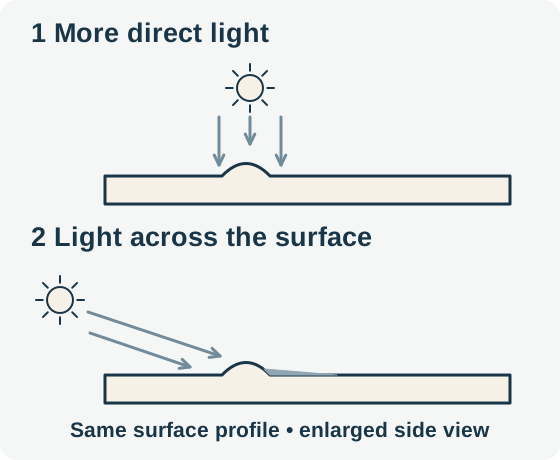
Lighting direction can make a surface irregularity more noticeable. This enlarged profile explains the relationship; it is not a measured sheen comparison.
- More direct light: compare the wall from the positions and under the lighting normally used in the room.
- Light across the surface: an oblique light can emphasize a ridge or texture difference. Include this view when agreeing on repair and preparation expectations.
Concept references: USG guidance on critical light.
Ask the painter to inspect the prepared wall before finishing, particularly where a long window casts light across it. Decide whether the goal is to preserve an older surface’s character or produce a more uniform plane. Full-wall smoothing is a separate preparation choice and should be priced as such.
For older plaster, use the plaster painting guide to distinguish cosmetic preparation from attachment, movement and moisture repairs. The room’s wall material alone does not automatically choose the sheen or calculate the repair cost.
Cleaning can change the appearance of the finish
A shiny spot left after scrubbing may be burnishing rather than dirt that still needs more cleaning. Benjamin Moore’s burnishing guidance identifies rubbing, repeated washing and abrasive cleaning among the causes of changes in sheen. Continuing to scrub the same spot can make the mismatch more noticeable.
Keep the paint’s care instructions with the project record. Confirm when the selected finish may be washed and which cleaning method it allows. “Dry to touch” is not a universal washing permission, and a cleaning interval from a different product is not a substitute for the one on your wall.
If a hallway has repeat contact from a chair, backpack or handrail approach, discuss both the paint choice and the source of rubbing. A more suitable coating may help with maintenance, but removing the repeated contact can be part of the practical answer too.
Test the finish in the room
Compare a manageable number of choices using samples made in the actual product and sheen under consideration. A small color sample in a different formulation may help choose a hue without demonstrating the finished sheen or cleaning performance.
Put the samples where the light changes across the day and near the trim they will meet. Look from normal viewing positions, then from an angle. Record whether you notice wall texture, glare, a color shift or a strong contrast with adjacent surfaces. Those observations are more useful to your painter than “I want something in the middle.”
Agree on the transition between rooms. A doorway or wall corner can provide a natural finish boundary; a change halfway across one uninterrupted wall may be visible. If the same color continues through connected spaces, decide whether the sheen should also continue or whether the surfaces have genuinely different needs.
Keep a room finish schedule
A simple record prevents the phrase “the white paint” from covering several different products. Use one line for each surface type, not just each room.
| Record | Example of the detail to keep |
|---|---|
| Room and surface | Bedroom walls; bedroom ceiling; bedroom doors and trim |
| Product | Manufacturer and exact line or product number |
| Appearance | Color/formula and sheen, with approved sample noted |
| Preparation | Repairs, spot or full priming, and any texture work |
| Application | Work date and useful batch or applicator information |
| Care | Earliest permitted cleaning, allowed method and retained paint location |
Use it alongside the quote-comparison worksheet. It is especially useful when walls and woodwork are painted at different times.
Touch-up expectations belong in the decision
Even with the correct color and sheen, a later repair may show because the original surface has aged or the application texture differs. A small test can help determine whether a touch-up is acceptable or whether the wall should be recoated to a natural boundary. Our touch-up and flashing guide explains how to compare those options.
The instant interior estimator helps organize walls, ceilings, baseboards and door faces. A finish preference does not automatically apply a premium multiplier. Use the written quote to settle the exact coating, preparation and scope, and use the painting planning guide to organize room access while the work progresses.
The painting guide library includes the related trim, plaster and wall-repair decisions.