
PAINTING TROUBLESHOOTING · LEAVENWORTH
Why cabinet paint peels and how to define the repair
Leavenworth Painting · Updated October 28, 2026
Peeling cabinet paint means a coating has lost its bond to the layer below it. The important question is which layer is failing and why. A new coat over the top can cover the color difference while leaving that weak bond in place.
Before arranging a repaint, record where the failure occurs, what is exposed underneath and whether there is water damage, rubbing or a soft finish. Those observations help decide whether the work is a small repair, a broader coating removal or a material replacement. This guide explains what to look for without turning a photograph into a definite diagnosis.
Peeling, chipping and sticking are different clues
A chip at a hard impact point is not the same pattern as a film that releases across a door face. Likewise, two fresh painted surfaces sticking together can damage a coating without proving that every surface has the same problem.
Sherwin-Williams describes peeling as loss of adhesion to the substrate or an earlier coating. Its listed causes include moisture, dirty or glossy surfaces and coating over paint that already has marginal adhesion. The same source recommends checking the surrounding coating, not only the visibly peeled spot.
For cabinets, start with a location record rather than a product accusation:
| Pattern to photograph | Questions it raises | What not to conclude from the picture alone |
|---|---|---|
| Widespread sheets releasing from a door | Which coating interface is separating? Was the old surface sound and prepared? | That every primer or every water-based enamel is unsuitable |
| Chips near handles or a drawer pull | Is there repeated contact, impact or contamination? Is surrounding paint bonded? | That a small touch-up will necessarily blend or remain attached |
| Damage along a rubbing door edge | Is the door aligned? Are coated surfaces contacting each other? | That another coat will correct the fit |
| Failure below the sink or near an appliance | Is water, heat or another exposure contributing? Is the material itself damaged? | That paint can restore a swollen core |
| Soft or tacky paint | What coating was used, when, under what conditions and over which layers? | That an arbitrary extra week or a clear topcoat will solve it |
| Film lifting from a wrapped door | Is the wrapper separating from the core? | That it is ordinary paint peeling |
Treat these as inspection prompts. The cabinet material guide explains why wood, veneer, MDF, laminate and thermofoil need different decisions.
Find the failing layer before choosing a repair
A cabinet can have an original clear finish, an earlier primer, one or more repaints and a newer topcoat. The surface you see under a chip may be another coating rather than bare wood. White primer and white enamel can also be difficult to distinguish in a photograph.
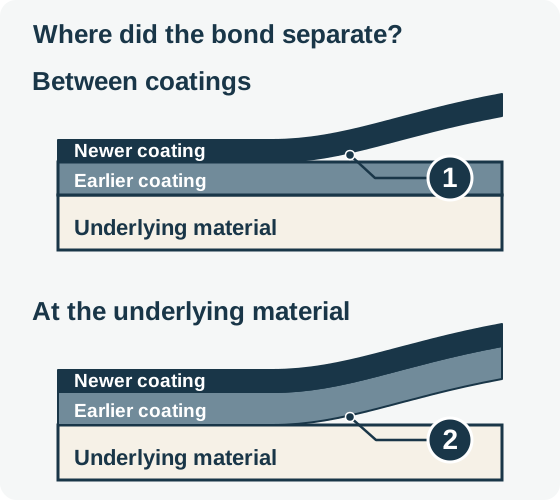
Identify the interface that failed before choosing what can stay. Layers and gaps are enlarged for clarity; this example is not a required primer-and-paint schedule.
- Between coatings: the upper, newer film separates from an earlier coating. The exposed surface may still be paint rather than bare material.
- At the material: the earlier coating separates from the underlying surface and carries the newer coating with it. A new topcoat does not restore that lower bond.
Concept references: Sherwin-Williams peeling guidance.
Ask the painter to identify what will remain and how its adhesion will be assessed. If a lower layer is unstable, applying a stronger coating over it does not make the lower layer stronger. The repair scope should describe removal back to a suitable base, without promising that every cabinet must be stripped to bare wood before it has been inspected.
Avoid picking, scraping or conducting improvised destructive tests just to provide a picture, especially on older painted surfaces. Provide the existing damage, the age of the kitchen if known, and any coating records. Preparation that disturbs old paint may require a different work setup; the lead-paint guide explains the questions to resolve before work begins.
Cleaning and bonding are separate from hiding the damage
Kitchen surfaces can carry cooking residue, hand oils or products used during cleaning and polishing. A clean-looking face is not proof that every contaminant has been removed. The preparation method must suit both the surface and the proposed coating.
Sherwin-Williams’ cabinet preparation guidance calls for cleaning and a test area of the proposed bonding primer before committing to the whole surface. The useful principle is to establish the bond after preparation. It is not a guarantee that one primer works on all cabinets or that a test area repairs damaged material.
A repair can also have two separate goals: making the coating attach and making the repaired area look consistent. Feathering an edge, filling a chip or preparing a scratch deals with appearance. Selecting a compatible system deals with the new bond. Ask the estimate to address both, including whether an entire door face needs recoating to achieve a consistent finish.
Decide between a spot repair and a larger repaint
A limited repair is worth considering when the cause is localized, the surrounding coating is sound and the appearance can be matched acceptably. A larger repaint becomes more relevant when poor adhesion is widespread, the old product is unknown or many repairs would leave an inconsistent finish.
Material replacement may be the more useful discussion when a door is warped, a core is swollen, veneer is detached or a wrapper is failing. Paint can change the appearance of sound material; it is not structural repair.
Ask for the decision in two stages if the extent is uncertain: an initial assessment or agreed test, then a defined repair scope. A quote that explains what happens if more loose coating is found is more useful than one that assumes all hidden layers will behave perfectly. Use the scope-comparison worksheet to record that contingency.
A new topcoat does not reset every clock
Recoat time, careful handling, return to gentle use and normal cleaning are separate milestones. A cabinet that feels dry can still be vulnerable to pressure or contact. The actual coating and conditions determine the instructions.
Before declaring that a finish “just needs to cure,” establish whether the problem is slow development, an incompatible layer, contamination, excessive film or physical damage. Waiting does not reattach a film that has already separated. Adding a clear finish also changes the system and should not be used as an unsourced rescue recipe.
The cabinet paint specification guide compares documented product instructions and explains why one enamel’s timing cannot be transferred to another. For an existing problem, keep the paint cans or written product record; the brand name and color alone may not identify the material.
What a useful repair proposal should say
- The likely cause and the observations supporting it, including remaining uncertainty.
- Which doors, drawer fronts, fixed boxes and inside surfaces are affected.
- What coating or damaged material must be removed, repaired or replaced.
- The preparation, primer and finish proposed for the remaining surface.
- How the repair will match the surrounding color, sheen and texture.
- Any hinge, rubbing, water or access issue that must be addressed separately.
- The handling and cleaning instructions, plus the process for an unexpected finding.
If you have an existing workmanship concern, preserve the original quote, product information and dated photographs before starting another contractor’s work. Describe the issue to the original painter and ask how it will be assessed. The appearance alone does not determine whether the cause falls within a particular written warranty.
For a Leavenworth cabinet assessment, include the locations of the damage and how long the problem has been visible in your quote request. Keep wide views and close-ups ready for the follow-up. Our cabinet painting page explains the larger repaint scope once the existing surface is understood.
Use the painting guide library for related coating and finish-planning questions.