
PAINTING GUIDES · LEAVENWORTH
Repainting fiber-cement siding
Leavenworth Painting · Published October 28, 2026
Fiber-cement siding can be repainted, but the right scope starts with identifying the siding and its existing finish. Factory-finished boards, field-painted primed boards and damaged material need different decisions. A repaint can renew a suitable finish; it cannot correct cracked boards, failed installation details or a recurring water problem.
For a Leavenworth project, use this guide to prepare for an exterior painting assessment. The most valuable records are the siding manufacturer, product or profile, installation date and any original finish or warranty documents.
Confirm that the siding is fiber cement
Painted lap siding is not one material. Solid wood, modern engineered wood, older hardboard, vinyl and fiber cement can all appear in similar profiles. The distinction changes cleaning, edge treatment, repair and coating choices.
James Hardie’s material description identifies its fiber cement as a mixture including sand, water, cellulose fibers and Portland cement. LP SmartSide is engineered wood, a different product family with its own care and maintenance instructions. “Hardie,” “hardboard” and “LP” should not be used interchangeably on an estimate.
If records are missing, ask the person inspecting the siding to identify it from available markings and existing details without destructive investigation. Do not grind, cut or sand unknown siding to identify it. Older cement-like siding can raise different material and hazard questions that should be resolved before disturbance.
| What you have | What the repaint plan needs to establish |
|---|---|
| Factory-finished fiber cement | Original finish system, allowed touch-up or repaint methods, remaining warranty |
| Factory-primed fiber cement painted after installation | Existing field-applied coating, condition and compatible repaint system |
| A previously repainted factory finish | Condition of both the repaint and underlying finish; which layer is failing |
| Cracked or damaged boards | Whether a manufacturer-approved repair is suitable or material replacement is needed |
| Engineered wood or older hardboard | The correct manufacturer’s wood-product guidance rather than fiber-cement assumptions |
Distinguish a touch-up from a full repaint
An isolated nick in an otherwise sound factory finish is not the same project as changing the color of an entire elevation. Touch-up materials and application limits may be designed for small defects. Broad use can produce a different sheen or weathering pattern from the factory coating.
James Hardie’s FAQ distinguishes its primed siding from factory-applied ColorPlus finishes and directs owners to its matching touch-up products for nicks and scrapes. It also states that the exterior siding can be repainted when a color change is desired. Before working on a ColorPlus surface, obtain the current instructions for the installed product and the particular repair or full repaint being proposed.
If damage may be covered by an existing warranty, document it and check the claim process before altering it. Keep “repairing the original factory finish” and “installing a new field-applied finish” separate in the quote. A field repaint should not be presented as recreating the original factory application or renewing its warranty.
Inspect the whole wall, not just the paint
Record the condition around windows, roof intersections, lower courses, utility penetrations and transitions between materials. Look from safe access for broken edges, cracks, displaced boards, stained joints and persistent wet areas. Note where the finish problem repeats after previous touch-ups.
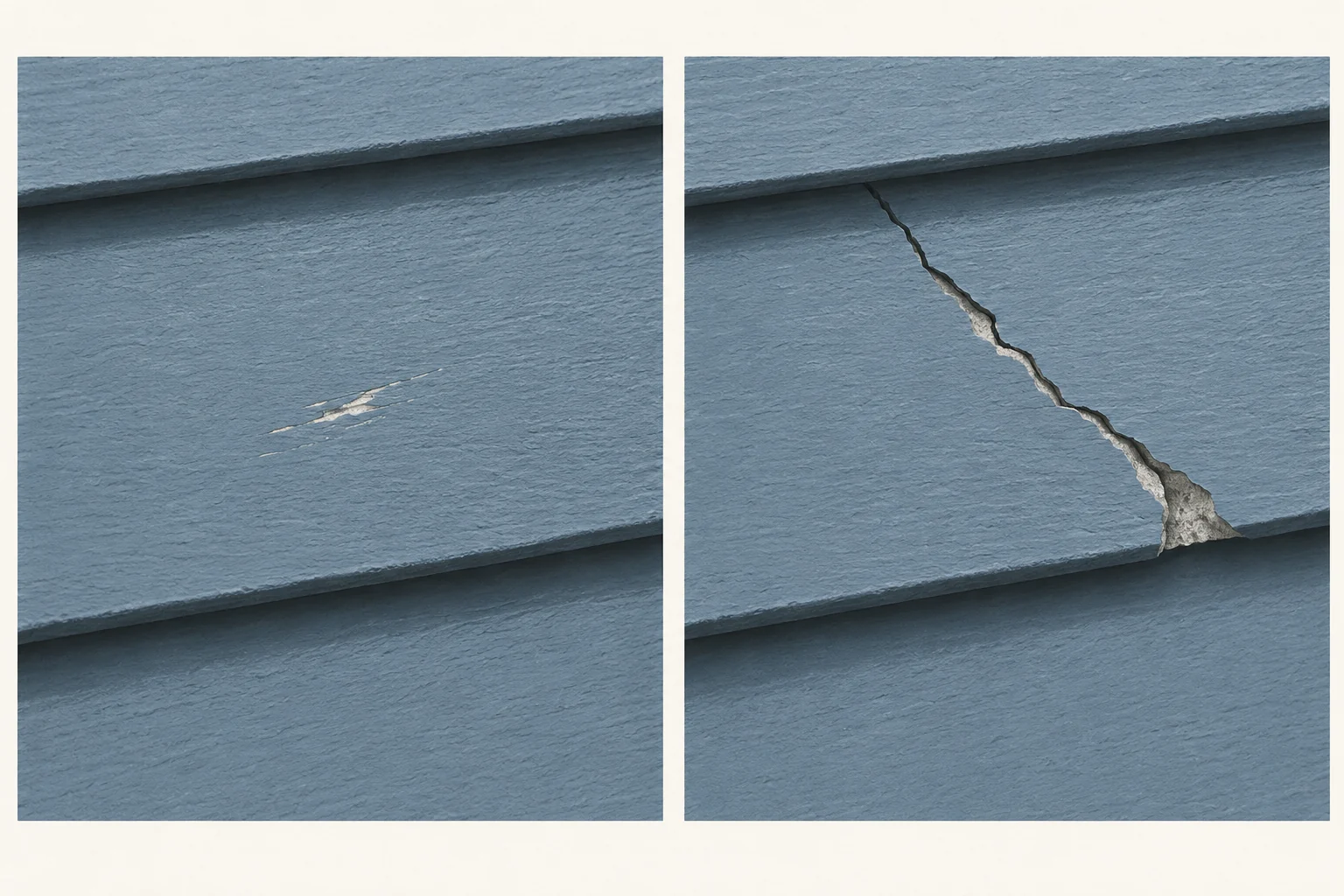
A painter should explain which findings are coating work and which need a siding or building-envelope repair. Caulk cannot restore a broken board. Paint cannot replace flashing. A clean-looking surface after washing does not prove that water-management details behind the siding are correct.
Ask that uncertain conditions remain visible long enough to assess. Covering a crack with filler before establishing why it formed can erase a useful clue. If replacement is required, identify who will match the product and handle fastening, clearances, flashing and finish treatment.
Use cleaning methods accepted for the siding
Start with the siding and finish manufacturer’s instructions. James Hardie’s care guidance discusses gentle cleaning methods and warns about damage from high-pressure washing. Cleaning is meant to remove contamination without eroding the surface or harming the finish.
The preparation scope should name the cleaner or treatment for the actual contamination, the rinse method and the protection for nearby materials. Different marks can require different responses. A dark spot should not automatically be treated as mildew, and a brown run should not automatically be treated as a wood stain on a cement-based board.
Allow the surface to meet the coating’s dryness requirements after washing. Wet joints, shaded walls and recently saturated areas may need different timing from exposed flat surfaces. “Wash today, paint tomorrow” is a scheduling assumption until conditions support it.
Do not seal every joint
The visible joint is only part of the wall assembly. Some details are sealed; others rely on flashing, overlap, clearance or drainage. Requirements differ among lap siding, panels, trim products and installation systems.
Before recaulking, ask the contractor to consult the installation instructions for the exact Hardie product or the corresponding documents from the actual manufacturer. Mark which joints need maintenance and which must remain open. A blanket promise to “caulk all seams and bottom edges” is not a technically complete plan.
Where sealant is appropriate, it also has its own surface, application and paint-ready requirements. The finish coat’s low-temperature rating does not automatically apply to the sealant underneath it.
Choose the coating system for the existing surface
Ask for the exact proposed topcoat and any primer, together with the preparation and coverage requirements. A repaint over a sound factory finish can require a different approach from exposed material, a repair patch or a weak earlier repaint.
For a specific example, the currently linked US HardiePlank HZ5 instructions, revision September 2019, recommend 100% acrylic topcoats. Their ColorPlus repaint section calls for a clean, dry surface and says repriming is normally unnecessary. It prohibits stain, oil/alkyd-base paint and powder coating on the named Hardie products, and directs finish application to the paint manufacturer’s coverage, method and temperature instructions. Read the HardiePlank HZ5 document for the complete scope. This is guidance for that identified system, not every fiber-cement manufacturer or every damaged surface.
Primer should have a defined job. It may be specified for a repair, exposed material or a compatibility issue; it should not be added or omitted from habit. Obtain agreement between the siding’s instructions and the coating manufacturer’s recommendations if they appear to conflict.
For an unknown earlier coating, a representative assessment can help determine adhesion and appearance before expanding the work. If paint is lifting in sheets, putting a higher-priced product over it does not establish a reliable base. The exterior peeling guide explains why the layer that separates matters.
Sheen and color should be sampled on a suitable surface and viewed in more than one light condition. Confirm any material-specific color restrictions before the final selection. Do not borrow vinyl color rules and apply them automatically to fiber cement, or assume that the absence of a vinyl rule eliminates every product limitation.
Write the estimate around the actual scope
Compare proposals using the same list of surfaces and repairs:
- Siding manufacturer, product and original finish where known.
- Cleaning and removal of failed coating, including any representative assessment.
- Board repairs or replacement, with responsibility for installation details.
- Specific joints to receive sealant and drainage details to preserve.
- Primer and finish system, color, sheen, coats and coverage requirements.
- Access, protection of adjacent surfaces and weather-related sequencing.
- Treatment of additional damage found during preparation.
Ask how touch-up appearance will be judged if only a few areas are being repaired. On a full repaint, discuss edges, returns and transitions so that the written scope matches what you expect to see from the yard and entry.
Maintain by condition rather than a promised lifespan
A long siding warranty is not a repaint schedule. Track coating condition, joint maintenance and water management separately. Inspect for changes after significant weather and during routine home maintenance. Keep the product and tint records so later repairs can begin with the correct information.
Fading by itself can be an appearance decision. Cracking, peeling, damaged material or persistent staining calls for a closer assessment. Use how often to repaint a Kansas house to separate cleaning, localized maintenance and a broader repaint, and the season guide to plan a suitable application window.
To start a quote, describe the siding, known finish, visible damage and whether you want to preserve or change the color. Keep installation records and photographs ready for follow-up. The complete painting planning guide covers the remaining scope and scheduling questions.
Browse the painting guide library for related preparation and finish decisions.